 Dallas Fort Worth Injury Lawyer Blog


Medically Reviewed & Written by Dr. Shezad Malik, M.D., J.D., Board-Certified Physician & Trial Attorney
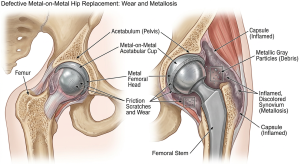
High-friction grinding between the cobalt-chromium ball and liner causes premature mechanical wear and leaches toxic metal ions directly into the surrounding joint tissue.
If you or a loved one received a hip replacement over the past two decades, you could be living with a ticking time bomb inside your body.
What medical device manufacturers originally marketed as a breakthrough in orthopedic technology, promising durable, long-lasting solutions for active patients has instead resulted in widespread patient suffering, global device recalls, and massive multidistrict litigation (MDL).
Do I Qualify? Metal-on-Metal Hip Revision Lawsuit Criteria
| Evaluation Factor | Qualified Case Criteria | Disqualified Hip Case |
|---|---|---|
| Surgical Status |
✅
Patient has already undergone a hip revision surgery, or an orthopedic specialist has formally documented that a corrective replacement is medically necessary due to active implant failure.
|
❌
The original hip implant is functioning well with no documented clinical complications, no physical side effects, and no planned replacement or extraction surgeries.
|
| Diagnostic Proof |
✅
Confirmed medical diagnosis of metallosis, blood laboratory panels showing elevated cobalt or chromium levels, MARS-MRI showing pseudotumors, or localized bone destruction (osteolysis).
|
❌
The joint failure or revision surgery was caused exclusively by an unrelated post-operative infection, severe physical impact trauma from a car crash or fall, or ordinary natural wear after 15+ years.
|
| Device Match |
✅
The model matches a recalled line or design flaw from major brands including Exactech, Smith & Nephew, DePuy (J&J), Stryker, Zimmer Biomet, or Wright Medical.
|
❌
The implant is a completely different style (such as an all-ceramic joint or a standard modern plastic liner) with no design defects or defective packaging recall history.
|
| Legal Timelines |
✅
The discovery of the device defect, the onset of severe metallosis symptoms, or the corrective revision surgery took place within your state’s active statute of limitations window.
|
❌
The patient was fully aware of the defective implant failure and underwent revision surgery many years ago, missing the applicable state product liability statutory filing deadlines.
|
As both a medical doctor and a product liability trial attorney, I am tracking these defective joint replacements closely.
As we move through 2026, a secondary wave of late-manifesting device failures is emerging. Patients who believed their implants were stable are now experiencing severe medical complications, toxic metal poisoning, and the frightening reality of high-risk corrective surgeries.
Below is a critical metal on metal hip update 2026 on the clinical dangers of metal wear debris and the current status of major manufacturer lawsuits.
Mechanisms of Metal-on-Metal Hip Implant Failure and Wear Debris Release
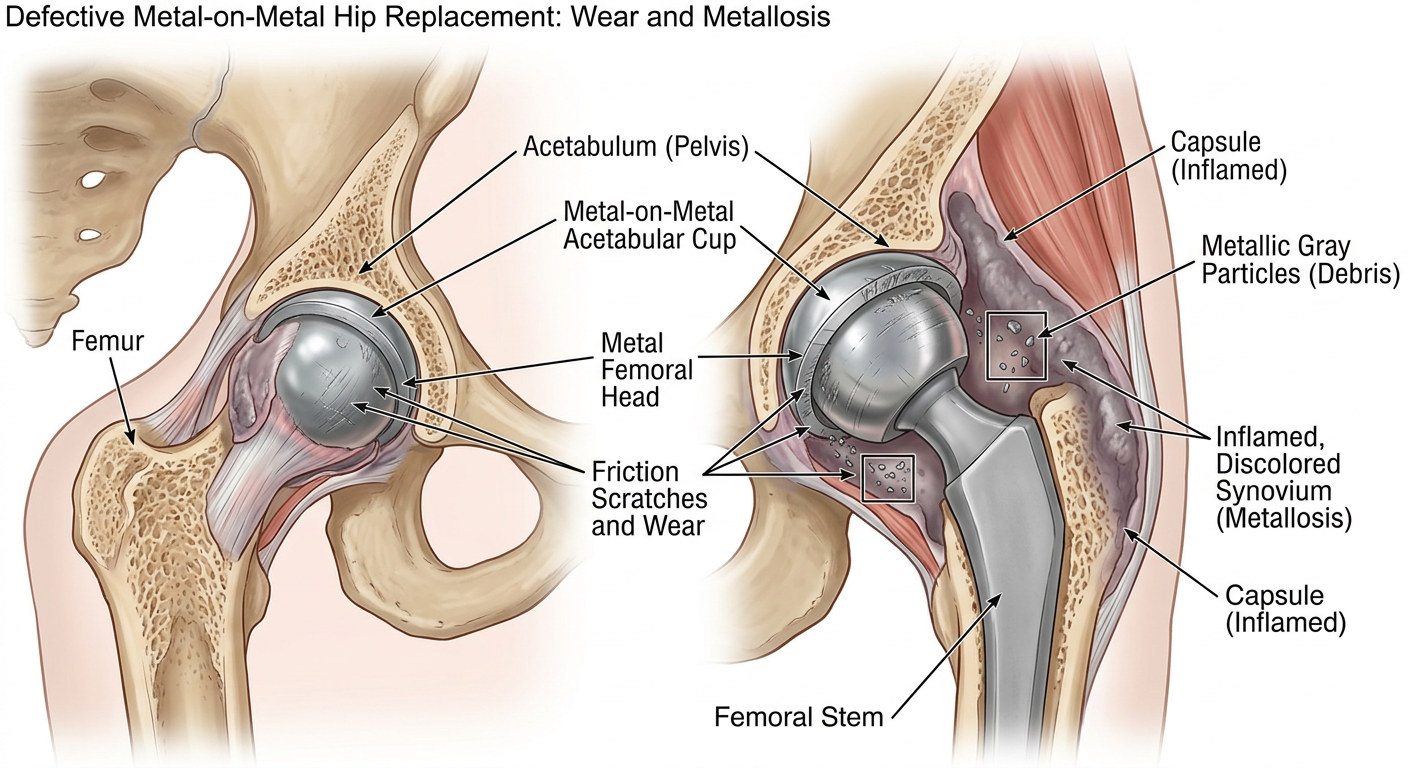
Medical illustration detailing the mechanical failure and toxic ion shedding of recalled metal-on-metal hip replacements analyzed by product liability attorney Dr. Shezad Malik.
Figure 1: High-friction grinding between the cobalt-chromium ball and liner causes premature mechanical wear, surface scoring, and leaches toxic metal ions directly into the surrounding joint tissue.
The image above illustrates the mechanical engineering failure inherent in modern metal-on-metal (MoM) hip designs.
Unlike standard implants that utilize a plastic or ceramic liner to absorb movement, these systems force a heavy cobalt-chromium alloy femoral head to grind directly against a matching metal acetabular cup.
Over time, normal daily walking generates intense structural friction. As shown, this continuous grinding causes microscopic surface scratches, fretting, and galvanic corrosion.
The immediate clinical result is the release of billions of invisible, sharp metal shards and toxic ions into the surrounding joint space, destroying local muscle tissue and infiltrating the patient’s bloodstream.
Metal on Metal hip update 2026 The Medical Crisis: Why Metal-on-Metal Hips Fail
The fundamental defect of a metal-on-metal (MoM) hip implant stems from its basic structural design: a solid metal ball moving directly within a solid metal cup or liner.
Unlike traditional implants that utilize ceramic or high-density polyethylene (plastic) to minimize friction, MoM implants rely on a cobalt-chromium alloy grinding against itself.
Normal daily activities like walking, climbing stairs, or standing up exert immense mechanical pressure on this joint interface.
Over time, this continuous friction releases billions of microscopic cobalt and chromium nanoparticles directly into the surrounding joint capsule and the patient’s bloodstream.
This toxic debris triggers an aggressive immune response known as Adverse Reactions to Metal Debris (ARMD) or Adverse Local Tissue Reactions (ALTR).
Clinically, this destructive physiological process manifests in several severe ways:
Metallosis:
This is the severe, localized destruction of soft tissue, muscle groups, and bone anchors caused by accumulated metal shards.
The surrounding tissue turns black and necrotic (dies), severely compromising the stability of the hip.
Pseudotumors:
These are non-cancerous, fluid-filled or solid masses that form as a foreign body reaction to the metal ions. As they grow, they compress localized nerves, destroy nearby musculature, and cause chronic, debilitating joint pain.
Systemic Metal Poisoning (Cobaltism):
Once cobalt and chromium ions cross the joint capsule and saturate the bloodstream, they travel to vital organs. High serum metal levels are clinically linked to severe neurological damage (including cognitive decline and peripheral neuropathy), thyroid dysfunction (hypothyroidism), and cardiomyopathy (weakening of the heart muscle leading to heart failure).
Osteolysis & Loosening:
The body’s immune system attempts to digest the metal debris by releasing destructive enzymes. These enzymes inadvertently eat away at the living bone surrounding the prosthesis.
This bone destruction (osteolysis) destabilizes the implant, causing it to shift, tilt, or loosen, which forces patients to undergo complex, high-risk revision surgery.
| Systemic Target | Cobaltism & Metal Ion Poisoning Complications |
|---|---|
| Cardiovascular Damage | Cobalt-Induced Cardiomyopathy: Toxic metal ions accumulating in heart tissue can weaken the heart muscle, leading to unexplained shortness of breath, irregular heartbeats (arrhythmias), or progressive heart failure. |
| Thyroid Dysfunction | Severe Hypothyroidism: High serum cobalt concentrations directly inhibit normal thyroid hormone synthesis. This frequently manifests as rapid weight gain, chronic fatigue, cold intolerance, or unexplained neck discomfort. |
| Neurological Impairment | Cognitive & Nerve Decline: Systemic metal toxicity can cause peripheral neuropathy (numbness, burning, or tingling in limbs), chronic headaches, and cognitive changes mimicking early-onset dementia. |
| Sensory Deterioration | Ocular & Auditory Loss: Chronic exposure to circulating metallosis ions can damage the central nervous system, leading to rapidly blurring vision, tinnitus (persistent ringing in the ears), or permanent hearing loss. |
Recognizing the Signs of a Failing Hip Implant
Many patients mistakenly believe that if they are not in pain, their implant is functioning fine. However, it must be emphasized that silent tissue destruction often precedes physical pain.
You must monitor yourself closely for any of the following localized or systemic warning signs:
Localized Orthopedic Complications & Tissue Destruction
| Clinical Indicator | Patient Warning Signs & Symptoms |
|---|---|
| Localized Orthopedic Pain | Persistent, deep aching pain localized in the groin, thigh, or buttocks regions that does not subside with rest. |
| Mechanical Joint Noises | An audible or physically felt clicking, popping, squeaking, or grinding noise within the joint capsule during daily movement. |
| Prosthesis Instability | A distinct feeling of structural joint instability, or the sudden sensation that the hip implant is catching, slipping, or completely giving way when bearing your body weight. |
| Gait Alterations | Unexplained, chronic soft tissue swelling surrounding the hip area or a progressive, worsening limp in your natural walking gait. |
2026 Legal Status: Major Device Manufacturer Lawsuits
Navigating the litigation landscape surrounding defective medical devices requires tracking shifting court dockets, corporate bankruptcies, and appellate rulings.
In 2026, several high-profile hip implant litigations are reaching a critical turning point.
1. Exactech: Bankruptcy Stay and Litigation Limbo
While not an all-metal design, the Exactech Connexion GXL polyethylene liner used across the Acumatch, MCS, and Novation systems remains a focal point of widespread joint failure and intense legal scrutiny in 2026.
The Defect:
Exactech distributed its hip, knee, and ankle replacements in defective packaging that lacked a critical oxygen barrier layer.
This manufacturing flaw allowed environmental oxygen to bleed into the packages, causing the underlying plastic liners to oxidize and prematurely degrade prior to ever being implanted in a patient.
Once inside the body, the brittle plastic sheds mass volumes of plastic debris, causing rapid osteolysis and catastrophic device failure.
Current 2026 Litigation Status:
Exactech filed for Chapter 11 bankruptcy. This action triggered an automatic stay, which temporarily halts all active product liability lawsuits across state courts and the federal consolidated litigation (MDL No. 3044 in the U.S. District Court for the Eastern District of New York).
Recent Developments:
As of July 2026, there were 1,838 pending lawsuits in multidistrict litigation before the U.S. District Court for the Eastern District of New York. There are also over 700 cases pending in a consolidated Florida state court action. All of these cases sit paused while the Delaware bankruptcy proceedings unfold.
Notably, Exactech agreed to an $8 million False Claims Act settlement to resolve whistleblower allegations regarding Medicare and VA billing for these defective devices.
Our firm is actively monitoring the bankruptcy court to protect our clients’ rights to a financial recovery once the stay is lifted or restructured.
2. Smith & Nephew:
BHR System Sunset and Ongoing MDL Dismissals
The Smith & Nephew Birmingham Hip Resurfacing (BHR) System and the R3 Acetabular System have faced intensive global scrutiny due to their high friction wear characteristics and early revision rates, particularly in female patients and individuals requiring smaller device sizes.
The Defect:
The BHR design features a large metal femoral head rotating against a metal cup, leading to excessive metal ion shedding when the components are misaligned even slightly by standard surgical tolerances.
Current 2026 Litigation Status:
Federal claims remain centralized under MDL No. 2775 in the U.S. District Court for the District of Maryland.
Recent Developments:
The litigation faces stiff headwinds as the court has progressively dismissed various claims on summary judgment and federal preemption grounds over recent terms.
Because the BHR system obtained the FDA’s strict Pre-Market Approval (PMA) pathway, the manufacturer enjoys a high degree of protection from state law product liability claims.
Concurrently, industry tracking indicates Smith & Nephew is actively sunsetting the legacy BHR design, limiting remaining inventory to a select group of high-volume surgeons as the global orthopedic market transitions entirely toward alternative, safer materials.
3. DePuy (Johnson & Johnson):
The Threat of Delayed Failures DePuy’s ASR XL Acetabular System (the subject of a historic global recall) and the metal-on-metal version of the Pinnacle Ultamet hip have collectively driven tens of thousands of lawsuits over the last 15 years.
Current 2026 Status:
While the vast majority of historical claims were resolved through multi-billion-dollar multidistrict litigation settlements years ago, the litigation is far from dead.
In 2026, we are seeing a spike in delayed long-term failures. Implants that lasted 10 or 15 years are now hitting their biological threshold, shedding toxic levels of cobalt and chromium, and forcing elderly patients into necessary, high-risk revision surgeries.
If you were excluded from past settlements because your hip was functioning at the time, your late-stage failure may still give you grounds for a lawsuit.
4. Stryker: Corrosion at the Modular Junctions
Stryker’s Rejuvenate, ABG II Modular-Neck Stem Systems, and the LFIT Anatomic CoCr V40 Femoral Heads are notorious for a unique mechanism of failure known as fretting and galvanic corrosion at the modular neck junction.
The Defect:
Instead of wear occurring solely inside the hip socket, Stryker devices experience severe corrosion at the stem-neck taper lock joint, the spot where two different metal components connect.
This corrosion causes the metal to dissolve, leading to sudden mechanical snaps, localized tissue necrosis, and acute metal poisoning.
Current 2026 Status:
While extensive global settlement frameworks took place to compensate early victims, our firm continues to actively review and monitor secondary complications arising from progressive tissue necrosis, severe muscle wasting, and delayed taper lock failures in patients who have not yet had their devices removed.
5. Zimmer Biomet & Wright Medical:
Legacy Failures Continue
High wear rates, severe local tissue reactions (ALVAL), and catastrophic neck fractures continue to plague historical recipients of the Biomet M2a-Magnum, the recalled Zimmer Durom Cup, and the Wright Medical Conserve Plus / Profemur lines.
Current 2026 Status:
Many of these legacy systems are no longer implanted, but hundreds of thousands remain inside patients.
The Wright Profemur line, notorious for modular neck fractures where the titanium stem snaps completely in half while a patient is walking, continues to drive high-stakes individual product liability lawsuits across state courts.
Protect Your Legal Rights After a Hip Implant Failure: Your Action Plan
If you suspect your hip implant is defective, you cannot afford to take a passive “wait and see” approach. You must act strategically to protect both your health and your legal rights before rigid statutory deadlines lapse.
| Action Item | Rationale & Immediate Steps for DFW Patients |
|---|---|
| Verify Your Implant ID | Contact your orthopedic surgeon or the surgical facility where your joint placement was performed. Explicitly request your complete operative report and the product identification sticker log sheet. This log sheet contains the exact brand, model, serial number, and manufacturing batch numbers required to identify recalled lots. |
| Monitor Blood Ion Levels | Have your physician order a specific heavy metals blood panel evaluating serum cobalt and chromium concentrations. Elevated ion markers provide concrete, undeniable scientific proof of internal device degradation and systemic toxicity before visible structural failure appears on standard X-rays. |
| Schedule Diagnostic Imaging | Reveal Hidden Tissue Damage: Traditional X-rays are excellent for viewing bone, but they completely miss early-stage soft tissue necrosis, muscle destruction, or pseudotumor formations. Request a metal debris-optimized MARS-MRI or a targeted ultrasound of the hip capsule. |
| Preserve Explanted Hardware | If you are undergoing revision surgery at a hospital, you must mandate in writing that the facility preserve the explanted hardware. Standard pathology labs frequently discard or return failed components to the manufacturer. This hardware is your legal property and serves as primary evidence in a product liability lawsuit; it must be stored using a certified chain-of-custody protocol. |
| Speak Directly With Us | Evaluating a defective medical device requires a sophisticated understanding of both civil litigation and clinical medicine. Our principal office in Dallas, Texas, reviews defective hip, and knee ankle cases nationwide. Call the Dr. Shezad Malik Law Firm directly at 214-390-3189 to protect your rights before strict statutory deadlines lapse. |
⚠️
Strict Statute of Limitations Warning
Do not delay. Every state enforces rigorous statutes of limitations that dictate exactly how long an injured patient has to file a product liability lawsuit against a medical device manufacturer. In many jurisdictions, the filing clock begins ticking the precise moment you discover—or reasonably should have discovered—that your hip replacement implant was defective, failing, or causing elevated blood metallosis levels. Waiting to see if your symptoms or bone loss worsen could permanently bar you from seeking financial justice and recovery nationwide.
Why Defective Hip Victims Nationwide Need a Dual MD/JD Trial Advocate
Litigating a complex product liability lawsuit against multi-billion-dollar medical device corporations requires a legal team that can cross-examine corporate medical directors on their own terms.
When device manufacturers attempt to deflect blame by claiming your joint failure was simply caused by ‘natural wear,’ patient lifestyle, or surgical error, our dual-perspective advocacy alters the courtroom landscape.
As both a medical doctor and an experienced trial attorney, I review your surgical reports, pathology slides, and blood metals panels with clinical precision, while simultaneously building an aggressive legal case that holds negligent corporations accountable in federal multi-district litigations (MDLs) and state courts across the United States.
We speak the language of medicine and the language of law fluently, ensuring that your injuries are accurately quantified and that your case receives the elite level of representation required to secure maximum compensation nationwide.
Speak Directly with the Dr. Shezad Malik Law Firm
Evaluating a defective medical device case requires a sophisticated, overlapping understanding of both complex civil litigation and clinical medicine. If you require representation, speak with our trial team specializing in defective medical device litigation immediately.
Our principal office in Dallas, Texas, proudly reviews defective hip, and knee cases nationwide. We represent clients on a contingency-fee basis, meaning you pay absolutely nothing upfront, and we only get paid if we secure financial compensation for your medical bills, lost wages, and pain and suffering.
Call Us Directly Today: 214-390-3189
If you or a loved one has suffered an implant fracture, severe metallosis, or required an early revision surgery, you must act strategically to protect your rights before statutory deadlines lapse.
Frequently Asked Questions: Metal-on-Metal Hip Litigation (2026 Update)
| Texas Jurisdictions Served & Case Review Regions | |
|---|---|
| Dallas-Fort Worth Metroplex | Primary North Texas Hubs: Dallas, Fort Worth, Plano, Arlington, Irving, Garland, Frisco, Grand Prairie, McKinney, Carrollton, Denton, Richardson, Lewisville, Allen, Flower Mound, Rowlett, Euless, Bedford, Grapevine, and Southlake. |
| Target Texas Counties | Regional Venue Filing Areas: Dallas County, Tarrant County, Collin County, Denton County, Rockwall County, Ellis County, Kaufman County, Johnson County, Parker County, Wise County, Harris County, Bexar County, and Travis County. |
| Statewide & Nationwide | Comprehensive Case Evaluation: While our principal office is located in Dallas, Texas, our medical-legal trial team reviews defective medical device litigation, orthopedic metal-on-metal hip failure claims, and multi-district litigation (MDL) cases for clients across all 50 states. |